

A first squint visit involves more than checking whether the eyes look straight. Your child’s vision, eye movements, alignment, focusing power and overall eye health are assessed with tests suited to their age, followed by a discussion of what happens next. Knowing what to bring and how the appointment works can make the visit less stressful and help you ask useful questions.
Key takeaways
- Bring previous glasses, eye reports, medicines, and the referral letter.
- Cycloplegic refraction reveals the child’s accurate glasses prescription.
- Treatment may include glasses, patching, exercises, monitoring, or surgery.
- Follow-up visits track vision and eye alignment as the child grows.
What to bring and expect when you arrive
Bring the child’s previous glasses, eye reports, medication list, and any referral letter to registration. Staff will record the child’s name, age, contact details, and appointment reason.
The clinician will ask when the eye turn began, whether it is constant or appears when the child is tired, and whether there is double vision, headache, injury, or a family history of squint.
Prepare for the first visit with this checklist:
- Explain that the clinician will use lights, pictures, or toys to look at the eyes; avoid calling the visit a “test” or suggesting that injections are involved.
- Bring photographs or short videos showing the eye turning, especially if it happens only at certain times.
- Note previous eye examinations, patching, drops, illnesses, premature birth, and any change in schoolwork or depth perception.
- Let the child sleep and eat normally, and bring a familiar toy or comfort item. Tell the clinic about allergies before any drops are used.
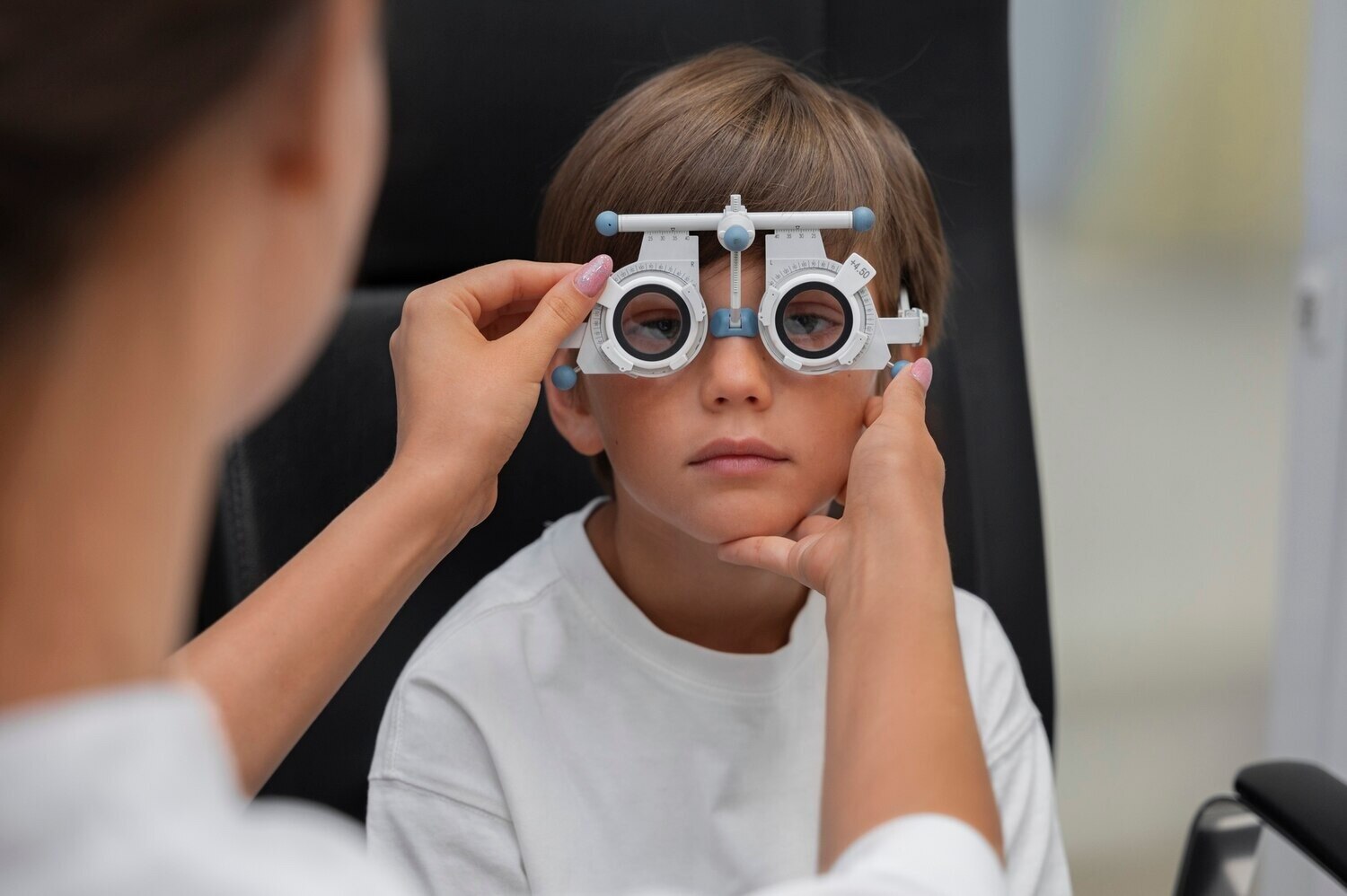
During the appointment, the clinician adapts the examination to the child’s age and cooperation. The visit may include checking each eye separately, observing fixation, covering one eye at a time, assessing eye movements, and examining the eyes after dilating drops.
Ask what type of deviation was found, whether vision differs between the eyes, when the next review is due, and which change requires earlier contact. This is more useful than choosing squint treatment in Panchkula by location alone.
How clinicians test vision and measure the eye turn
A child does not need to read letters for clinicians to test vision. They assess each eye separately using fixation on a light or toy, preferential-looking cards, picture-matching tests, or observation of how the child follows and holds a target.
A child squint specialist in Panchkula adapts the method to the child’s age, speech and cooperation.
The cover–uncover test shows whether one eye is genuinely deviated. The clinician covers one eye and watches the uncovered eye move; a correction movement indicates a manifest squint. The alternate-cover test prevents both eyes from working together and reveals the full deviation, including a latent tendency. A prism bar quantifies the size in prism dioptres.
The clinician repeats alignment checks at near and distance, during fixation on different targets, and when the child looks in various directions. This helps identify an intermittent turn that appears when the child is tired, inattentive or viewing far away.
Eye movements, pupils and the red reflex are checked for a paralytic, restrictive or other eye problem.
| Finding | Test or observation | What it helps show |
|---|---|---|
| True constant squint | Cover–uncover test | One eye is misaligned while the other fixes |
| Intermittent or hidden deviation | Alternate-cover test and repeated fixation | The turn appears, disappears or is revealed when fusion is interrupted |
| Pseudostrabismus | Corneal light reflex, cover tests and facial examination | A broad nasal bridge or epicanthal folds create a false crossed-eye appearance |
Why dilating drops and cycloplegic refraction matter
Cycloplegic refraction gives the clinician a reliable prescription by temporarily stopping the child’s active focusing. The clinician tests each eye separately, asks the child to look at a target, and uses retinoscopy or an autorefractor to measure how light focuses inside the eye.
Without cycloplegia, a child can over-focus and hide hyperopia, producing a prescription that is too weak.
Drops such as cyclopentolate or atropine serve two purposes: they widen the pupil for examination and relax the focusing muscle. A pediatric squint service in Panchkula should explain which drop was used, what the child may feel, and when the measurement will begin.
- Expect blurred near vision and increased sensitivity to light after the drops.
- Allow about 30 to 60 minutes for cyclopentolate to take effect before refraction; the clinic will set the exact waiting time.
- Expect atropine to last longer, with near blur and light sensitivity continuing into the next day or beyond.
- Bring sunglasses and avoid scheduling demanding close work immediately afterward.
The child can return to school if comfortable and able to manage blurred near vision, but staying home is more practical when reading, writing, or screen work is required. Ask the clinician when normal close work is safe, especially after atropine.
Never judge the final glasses prescription from the first quick reading taken before the drops have fully worked.
How the examination findings shape the care plan
A prescription is often the first treatment, not a sign that surgery is needed. Glasses correct significant refractive error and can reduce an accommodative squint; the clinician should state the prescription, wearing schedule and review date.
Amblyopia means one eye is seeing less well because the brain has favoured the other eye. The plan may add patching or atropine after glasses, with a stated dose or daily duration and a date to recheck vision.
Ask which finding applies:
- Pseudostrabismus: the eyes are aligned, but the eyelids or nose create a false appearance; treatment is usually observation.
- Typical childhood strabismus: repeated alignment measurements guide glasses, observation or alignment treatment.
- Paralytic or restrictive eye-movement problem: limited movement or an unusual pattern calls for further assessment.
- Amblyopia: unequal vision requires a vision-development plan, even if the eyes look straight.
Observation is not dismissal. It should include what will be measured, when the child returns and which change requires earlier review. Measurements can differ at near and distance or when a child is tired, so one examination does not always settle surgery.
A clear pediatric squint service in Panchkula will show you the diagnosis, each eye’s vision, the deviation in prism dioptres when measured, and the reason for every proposed step. Netra Eye Hospital can be judged by the same standard: leave knowing what happens next, why, and what would change the plan.
“Squint treatment in Panchkula” is not a diagnosis.
Related services
Scope Of Service at Netra Eye Hospital provides specialized eye care for infants, children, and adolescents, with a focus on the diagnosis and treatment of squint... View service → |
Clinical Services at Netra Eye Hospital provides specialized eye care services for infants, children, and adolescents. View service → |
What happens if alignment treatment continues after the first visit
Alignment treatment usually continues through repeat visits because the deviation can change with glasses, attention, fatigue, and age. Measurements are recorded in prism dioptres at near and distance, and clinicians compare results before changing treatment or discussing surgery.
A squint eye hospital in Panchkula should explain the target, follow-up interval, and change that requires earlier review.
Ask what each part of the plan is meant to achieve:
- Patching covers the stronger eye for the prescribed hours to treat amblyopia; it does not reposition the eye muscles.
- Atropine penalisation blurs the stronger eye at near and may cause light sensitivity; use it only on the prescribed schedule.
- Surgery discussion should include expected alignment, the possibility of residual or recurrent squint, and whether glasses or amblyopia treatment will continue.
- After surgery, redness, watering, mild soreness, and blurred vision can occur during early recovery; follow the surgeon’s instructions about rubbing, drops, bathing, and swimming.
Contact the surgical team urgently for severe or increasing pain, sudden reduction in vision, rapidly worsening swelling or redness, pus-like discharge, fever, repeated vomiting, or an eye that becomes difficult to open. Do not wait for the next routine appointment.
A failed patching schedule, missed glasses, or a new turn also deserves prompt advice, although it is not always an emergency.
Frequently asked questions
What should I bring to a pediatric squint appointment?
Bring the child’s previous glasses, eye reports, medication list, and referral letter. Registration records the child’s details and appointment reason.
How do clinicians measure a child’s squint?
Clinicians test each eye’s vision, assess eye movements, and measure the eye turn using alignment tests suited to the child’s age and cooperation.
Why are dilating drops and cycloplegic refraction used?
Dilating drops temporarily relax focusing muscles so clinicians can measure the child’s true refractive error and identify glasses needs accurately.
What can happen after the first squint assessment?
The plan depends on vision, eye alignment, focusing error, and eye health. It can include glasses, patching, exercises, observation, or surgery.
Why are follow-up visits needed for pediatric squint care?
Follow-ups show whether vision and alignment are improving, confirm treatment use, and identify changes that require a revised plan.